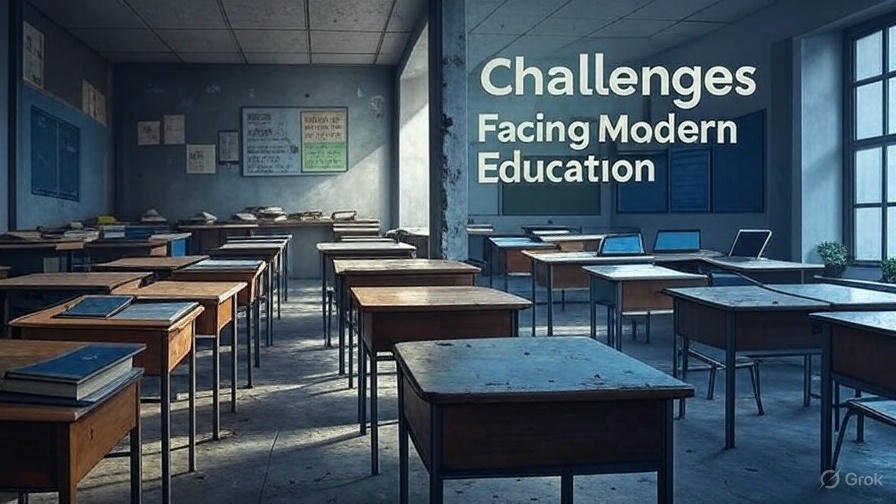
Today’s times are changing very fast, and this rapid change is also deeply affecting the system of time. Every day, new challenges are faced which are directly or indirectly affecting students, teachers and institutions. In earlier times, time was limited to books and classroom lectures, but today’s students are learning under the pressure of technology, globalization, and career competition.
The aim of modern education is not just to get a degree but to give students such skills that they can use in real life. But when the curriculum is outdated, teachers are underpaid, and infrastructure is weak, then the system becomes weak in securing the future of students. Apart from this, factors like social barriers, financial constraints, and digital divide are also becoming obstacles in making education inclusive and equal.
In this blog, we will take stock of the key challenges that modern education faces and explore possible solutions to those issues. We mustn’t just talk about the problems but also find solutions to them so that time can become accessible and valuable to everyone.
2. Unequal Access to Quality Education
One of the biggest challenges that today’s political system has to face is unequal access to quality education. This issue is not only in developing countries, but inequality between schools and students is prevalent in developed countries as well. One child has modern infrastructure, trained teachers, and updated learning tools, while another child is deprived of even basic textbooks and proper classrooms.
The biggest reason for this issue is the economic and geographic divide. In rural schools, there are neither complete teachers, nor electricity, nor access to the internet. In urban areas, there are still facilities, but the fees and competition there are so high that not every student can afford them.
Apart from this, issues of gender discrimination and disability also become a barrier to access. In many places, girls are not allowed to go to school, and basic schools are not built for special needs. All these factors together make education a distance for those who need it the most.
The solution to this problem is that the government and NGOs should come together and develop quality education facilities in remote areas. Teachers should be given training and incentives so that they work in backward areas. Until every child is not taught equally, the concept of equality will not come in society.
3. Outdated Curriculum and Lack of Skill-Based Learning:
The main aim of training is to provide students with tools and knowledge that they can use in their lives. But a big challenge of modern education is that the curriculum has become very old and theoretical. Students are made to cram every subject, but practical skills are not taught. Asr-e-hazir students need not just textbook knowledge but also problem-solving, communication, critical thinking and technology skills.
In our schools and colleges, the same topics are taught even today that were relevant 20 years ago. But today’s world is moving in the age of Artificial Intelligence, data science and remote working. If students are unfamiliar with these skills, they will not be able to compete in the job market.
Apart from this, important topics such as career counseling and personality development do not become a part of the curriculum. The result is that students acquire a degree but do not have the skills that employers seek.
The solution is to make the curriculum modern and market-relevant. Skill-based workshops, internships, and real-world projects should be made a part of the curriculum. Teachers should also be trained to guide students in both conceptual and practical ways. Until the curriculum learns to solve real-life problems, its impact will be limited.
4. Teacher Shortages and Burnout:
Teachers are the backbone of any administrative system, but in today’s times shortage of qualified and dedicated teachers has become a serious issue. In many schools either there is shortage of teachers or the ones who are there have so much workload that they get mentally and physically tired. This burnout not only affects their teaching quality but also directly impacts the learning of students.
Many teachers get low salaries, no job security and are also under pressure of administrative work. This is why instead of focusing on students they get engrossed in paperwork and extra duties. Even those passionate teachers who come into the system, after some time they become frustrated and resign.
This issue is not just limited to developing countries, teacher shortage is a major concern globally too. The situation has worsened after the pandemic where online teaching has posed new challenges for teachers.
The solution to this is that teachers should not only be given salary but also respect and opportunity for professional growth. Managing their workload, giving regular training, and taking care of their mental well-being should be part of the system. Only when teachers are happy and motivated, students will be able to learn better.
5. Technology Gaps and Digital Distractions:
Technology has definitely brought revolution in the world, but it has also brought some negative aspects which have become a challenge for modern education. The first challenge is technology gap not every student has access to internet, laptop or smart device. This digital divide leaves behind those students who live in remote areas or are facing financial issues.
Another issue is digital distraction. When students attend online classes, they easily get diverted towards social media, games, and irrelevant websites. The level of focus and concentration drops. Parents cannot monitor all the time, and it is also difficult for teachers to keep an eye on every student’s activity.
Increasing children’s screen time also affects their health and sleep patterns. The discipline and structure that is there in physical classes are lacking in an online setting. This weakens learning outcomes.
The solution to these challenges is that the government should provide low-cost internet and devices. Schools should adopt a hybrid model where there is a balance between online and offline learning. Parents should be taught digital parenting and students should be trained in responsible online behaviour. When technology is used wisely, it can become a powerful tool of education.
6. Conclusion:
The modern education system is facing many tough challenges, but overcoming these hurdles is not impossible. Every challenge has an opportunity hidden behind it – you just need to identify it and work on it. Whether it is an issue of access, outdated curriculum, teacher burnout or digital distractions, there is a solution to every issue.
At this time, the government, private sector, teachers, and parents all must work together to make the system better. Infrastructure will have to be improved, curriculum will have to be modernized, and teachers will have to be supported. The right use of technology has to be sought, and such a learning environment has to be created for students where they can learn freely and effectively.
Inclusive and equitable education should not be just a part of policy but should be a ground reality. Every child, wherever he is, however he is, should have the full right to acquire knowledge. When we give priority to knowledge, society will automatically grow, and the future will be secure.
This blog tells us that the issue of education is not just confined to schools and colleges, rather it is a collective responsibility. If we all join together and take even small steps, a big change can be brought about.
FAQs:
1. Why is there unequal access to quality education in many parts of the world?
Unequal access to education exists due to economic, geographic, and social divides. Rural areas often lack trained teachers, infrastructure, and internet access, while urban education can be too expensive. Additionally, gender discrimination and lack of support for children with disabilities further limit access to education.
2. How does an outdated curriculum affect students’ future?
An outdated curriculum limits students to theoretical knowledge and fails to prepare them for real-world challenges. Without skill-based learning, students lack essential abilities like critical thinking, communication, and technology usage, making it hard for them to compete in the modern job market.
3. What are the causes of teacher shortages and burnout?
Teacher shortages and burnout occur due to low salaries, high workloads, lack of job security, and administrative pressure. These factors reduce teaching quality and morale, leading many qualified teachers to leave the profession.
4. How is technology both a benefit and a challenge in modern education?
Technology has improved access to information and learning resources but has also created a digital divide. Many students lack access to devices and internet. Additionally, online learning often leads to distractions, health issues, and reduced student engagement.
5. What are some effective solutions to modern education challenges?
Solutions include modernizing the curriculum, investing in rural education, supporting and training teachers, bridging the digital divide with affordable tech, and creating balanced hybrid learning systems. Collaboration between governments, educators, and families is essential for lasting change.